Why Thermal Stress Relieving matters in Heavy Component Manufacturing
Filed Under: aggregate equipment , cone crusher repair , crusher components , gyratory crusher repair , heat treatment , heavy machining , main frame repair , main shaft repair , Marion Machine , mining equipment , precision machining , thermal stress relieving
Precision Starts Long Before Final Machining
At Marion Machine, we specialize in rebuilding, repairing, and manufacturing some of the largest and most critical components used in the aggregate and mining industries. From heavy-duty 7′ Symons cone crusher main frames to Metso 5474 gyratory crusher main shafts, precision and reliability are non-negotiable.
One of the key processes that helps us achieve those standards is thermal stress relieving.
Built for Large Components
Marion Machine operates a 10,000-cubic-foot furnace capable of handling some of the industry’s largest crusher and mining components. This massive furnace allows us to properly heat treat and stress relieve large castings, weldments, and shafts that would otherwise retain internal stresses from manufacturing or repair processes.
Whether we’re rebuilding a cone crusher main frame, repairing a gyratory shaft, or fabricating a large custom component, thermal stress relieving is an important step in ensuring dimensional stability and long-term performance.
What Is Thermal Stress Relieving?
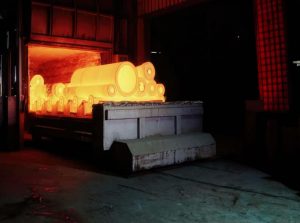 Thermal stress relieving is a controlled heat treatment process used to reduce residual stresses that develop within metal components during casting, welding, flame cutting, machining, and fabrication.
These internal stresses are often invisible to the naked eye but can create significant problems later in the manufacturing process or during equipment operation.
During stress relieving, a component is gradually heated to a specified temperature, held at that temperature for a calculated period of time, and then cooled under controlled conditions. This process allows internal stresses to redistribute and relax without altering the material’s overall mechanical properties.
Why Residual Stress Matters
Large crusher components are subjected to extreme forces during operation. If residual stresses remain locked into a component, several issues can occur:
- Distortion during machining
- Dimensional movement after machining is completed
- Difficulty maintaining critical tolerances
- Premature cracking around welded areas
- Reduced service life in demanding applications
A component may appear perfectly machined when it leaves the machine shop, only to move or distort later if residual stresses have not been addressed.
For critical components such as crusher main frames, eccentric housings, and gyratory shafts, even small dimensional changes can affect fit, alignment, and overall equipment performance.
Supporting Accurate Machining
Thermal stress relieving plays a major role in producing accurate machined surfaces.
When large castings or weld repairs are stress relieved prior to finish machining, the material is significantly more stable throughout the machining process. This allows machinists to hold tighter tolerances and helps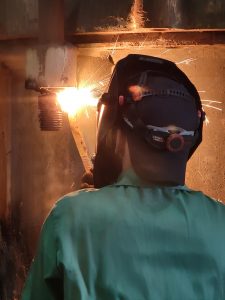 ensure that finished dimensions remain consistent after the part leaves the machine shop.
The result is better fit-up during assembly, improved component reliability, and fewer surprises in the field.
An Investment in Quality
Not every repair facility has the capability to stress relieve components of this size. Marion Machine’s 10,000-cubic-foot furnace represents a significant investment in quality and process control.
By performing thermal stress relieving in-house, we maintain complete control over scheduling, quality standards, and process consistency. This capability allows us to provide customers with repairs and manufactured components that meet the demanding requirements of the aggregate, mining, and industrial markets.
Built to Last
From a rebuilt 7′ Symons cone crusher main frame to a massive Metso 5474 gyratory main shaft, every component we produce is designed for long-term performance.
Thermal stress relieving is one of the many steps we take to ensure that our customers receive durable, dimensionally stable components that perform reliably in the toughest operating environments.
At Marion Machine, precision machining begins long before the first chip is cut—and thermal stress relieving is a critical part of that commitment to quality. Contact us today! Call 800.627.1639 or Click HERE.
Christopher Joyce Vulcan Materials of Winston-Salem, NC
Our Metso HP 800 Mainframe had a loose shaft and we re-fit the shaft back to OEM specs with a 2-week-turnaround to get a 3.5-million-ton-plant back up and running.