Crusher Repair and Rebuild Services: Restoring Equipment for Reliable Performance
In aggregate and mining operations, crusher reliability directly affects production. Wear, component damage, improper fits, and structural issues can eventually lead to reduced performance or unexpected downtime if they are not addressed.
When a crusher requires more than routine maintenance, a professional repair or rebuild can restore critical components and help return the machine to proper operating condition.
Since 1934, Marion Machine has specialized in large-scale rock crusher repair, machining, and rebuilding. With more than 2,000 crushers rebuilt, our team combines decades of hands-on experience with the equipment and processes required to repair some of the industry’s largest crushing equipment.
What Does a Crusher Repair or Rebuild Involve?
Crusher repair is rarely a one-size-fits-all process. The extent of the work depends on the crusher, its operating history, component condition, and the type of damage or wear identified during inspection.
A repair may focus on an individual component, while a more extensive crusher rebuild can involve disassembly, inspection, repair, precision machining, reassembly, and testing.
Marion Machine’s capabilities include large-scale machining, welding, thermal stress relieving, component repair, and complete crusher rebuilds. Our facility is equipped to work on jaw, cone, gyratory, and impact crushers from major equipment manufacturers.
Inspection Comes Before the Repair
An effective crusher repair starts with understanding the condition of the equipment.
Components are carefully inspected to identify wear, fractures, dimensional issues, and other conditions that need to be addressed. Depending on the repair, Marion Machine’s process can include stress fracture evaluation, dimensional measurements, bore alignment checks, and visual inspection.
This detailed evaluation helps determine the appropriate repair process before machining or welding begins.
Precision Machining Restores Critical Crusher Components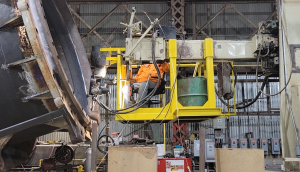
Crusher components operate under demanding loads, making proper dimensions, alignment, and component fits critical to reliable operation.
Marion Machine uses large-capacity lathes along with vertical and horizontal boring mills to machine heavy crusher components. During final machining, precision measurements are taken throughout the process to verify that repaired components conform to the required OEM specifications.
Depending on the condition of the equipment, machining may be used as part of repairs to worn bores, shafts, mainframes, and other major crusher components.
Welding and Thermal Stress Relieving for Heavy Crusher Repairs
When a crusher component has experienced structural damage or significant wear, machining may be only one part of the repair.
Marion Machine’s repair process can incorporate fracture removal, controlled welding, and thermal stress relieving. For applicable repairs, damaged material is removed beyond the identified fracture before the area is prepared for welding. Heat is carefully managed during the repair process, and components may undergo final thermal stress relief after welding and machining.
Marion Machine’s facility includes a 10,000-cubic-foot furnace designed to accommodate extremely large crusher components, allowing these processes to be performed on equipment that many conventional machine shops are not equipped to handle.
Quality Control Continues Throughout the Crusher Rebuild
Precision crusher repair requires more than checking a component when the job is finished.
Inspection and measurement take place throughout Marion Machine’s repair process. Machined surfaces are checked with precision measuring equipment, welds are visually inspected, bore alignment can be verified, and completed repairs are documented.
When applicable, a complete crusher can also undergo a no-load test run on Marion Machine’s dedicated crusher test stand. The test stand can accommodate a range of jaw, cone, gyratory, and impact crushers and provides another quality-control step before the equipment returns to the customer.
Large-Scale Capabilities Matter in Rock Crusher Repair
Crusher components can be exceptionally large and heavy, which limits the number of repair facilities capable of handling them properly.
Marion Machine’s Marion, North Carolina facility was built around large-scale crusher repair. Its capabilities include a 10,000-cubic-foot stress-relief furnace, welding capacity for components weighing up to 120,000 pounds, lathes with capacities up to 50 tons, more than 10 vertical and horizontal boring mills, and a dedicated crusher test stand.
Having these capabilities in one facility allows multiple stages of a crusher repair or rebuild to be completed by a team experienced specifically with heavy crushing equipment.
Repairing a Crusher Can Help Extend Its Service Life
Wear does not always mean a crusher or major component has reached the end of its useful life.
When damage can be properly repaired, rebuilding worn components can help extend the service life of existing crushing equipment while restoring critical dimensions and fits. It can also provide an alternative to replacing major equipment or components when a repair is technically appropriate.
The key is determining the condition of the equipment and selecting the correct repair process for the application.
Trust Marion Machine for Rock Crusher Repair and Rebuilding
For more than 90 years, Marion Machine has developed the experience and capabilities required to repair large crushing equipment for aggregate, mining, and other heavy industrial applications.
Whether your operation needs an individual crusher component repaired or a more extensive crusher rebuild, our team can inspect the equipment, determine the necessary repairs, and complete the precision machining, welding, stress relieving, and testing required for the job.
When big crushers need big repairs, trust Marion Machine.
Contact Marion Machine to discuss your crusher repair needs or learn more about our rock crusher repair and rebuilding capabilities.
Christopher Joyce Vulcan Materials of Winston-Salem, NC
Our Metso HP 800 Mainframe had a loose shaft and we re-fit the shaft back to OEM specs with a 2-week-turnaround to get a 3.5-million-ton-plant back up and running.